

- In this note:
- What I heard
- Who else helps
- Try it
- Your notes
What happens on the call
Thirty minutes on Zoom, nothing to prepare.
- You tell Gina what you are building and what is getting in the way. Three short questions when you book help the call start where you are.
- Together you name the real problem and one next move, whether or not we work together.
- If it is a fit, a one-page scope note with the fee arrives within two business days.
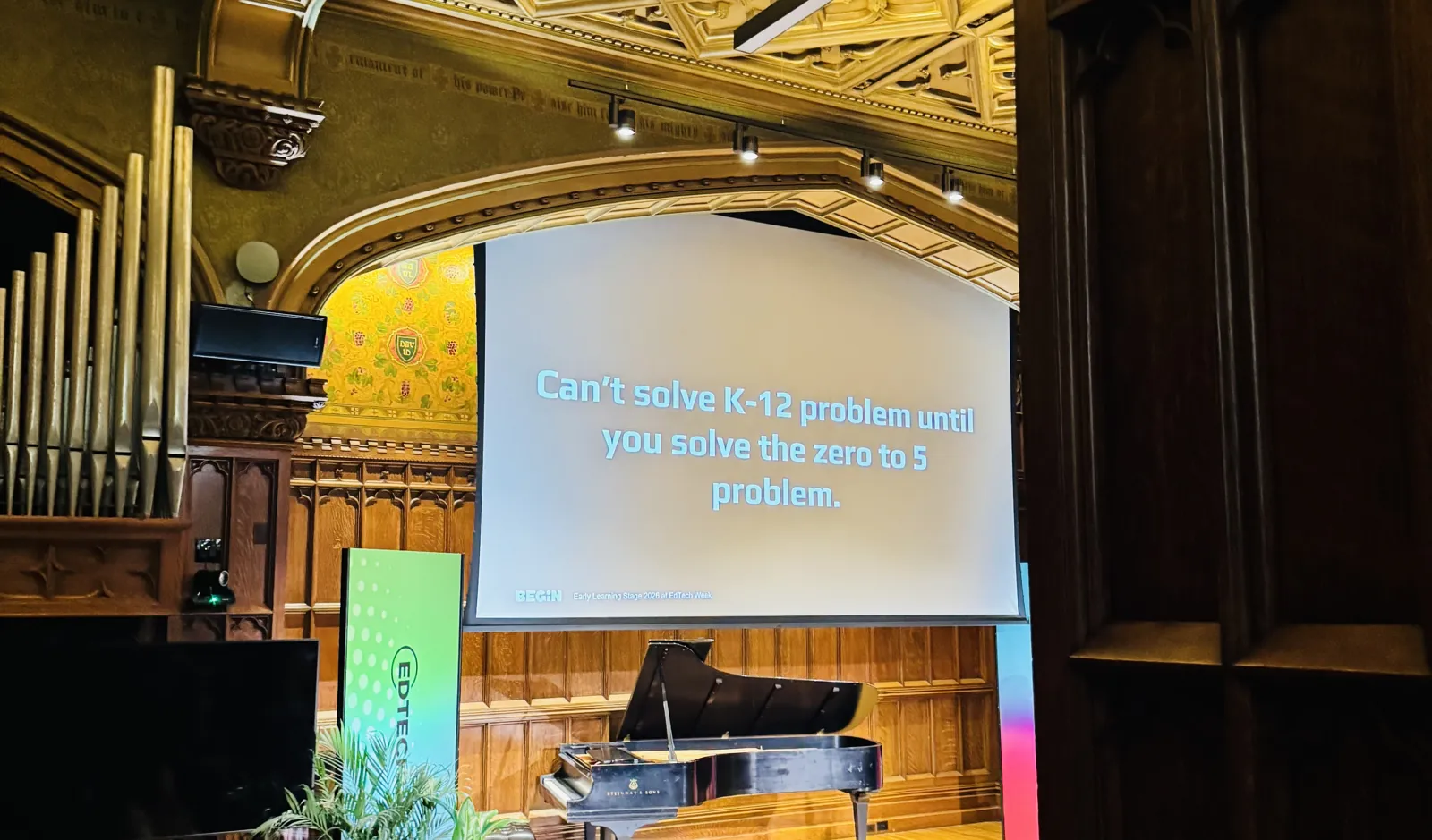
On Wednesday morning I sat in a wood-paneled hall at Teachers College, Columbia University, for the Early Learning Stage at EdTech Week. One slide stayed with me: “Can’t solve K-12 problem until you solve the zero to 5 problem.”
I have spent more than twenty years in education, from the special education classroom to curriculum leadership, and that line matches what I have seen. It also points past schools. If the work starts at birth and continues into a first job and the jobs after it, then schools are one part of a much larger picture. Families, education organizations, community groups, and local businesses fill in the rest.
What I heard on the Early Learning Stage
The session built its case on research many early educators know well.
- Readiness starts early. In a 2014 policy statement, the American Academy of Pediatrics noted that more than 1 in 3 American children start kindergarten without the language skills they need to learn to read.
- Early investment pays back. One slide showed the Heckman Curve, from Nobel economist James Heckman, which shows that the highest rate of economic return comes from the earliest investments in children. In a 2016 study, Heckman and colleagues found that two high-quality birth-to-five programs in North Carolina produced an annual return of 13 percent per child on their upfront costs.
- Learning does not stop at graduation. Another slide drew a person’s path as one line, from play to school to a job, then another job and another, with learning running the full length of it.
Put together, those slides describe a long road with many hands on it. That is where the rest of the community comes in.
Who else helps children get ready
Children learn at home, at the library, at the recreation center, at a grandparent’s kitchen table, and at the shop down the street. Meaningful outcomes, the kind that prepare every child for the future, go beyond test scores: reading on time, curiosity, confidence, the ability to work with other people, a sense of what work looks like, and adults outside school who know their name. Three groups outside the school building have a real part in that.
Education organizations
Tutoring programs, early learning providers, museums, libraries, education nonprofits, and education startups bring expertise and programs that schools often cannot build alone. They do the most good when they are easy for a principal, a parent, or a funder to understand and join.
Community organizations
Youth clubs, community centers, faith groups, and local foundations have something hard to build quickly: trust with families. They often reach parents of young children before any school does.
Local businesses
Businesses that do good locally make a difference. A small business can open its doors, lend its people’s skills, and support the parents on its own team. The research on that first one is encouraging. In a 2021 analysis of longitudinal data from eight countries, OECD researchers found that secondary students who explore, experience, and think about their futures in work often have lower unemployment as young adults. In Australia and the United States, taking part in workplace visits or job shadowing was associated with higher earnings later on. These are associations, so they do not prove cause, but they point in a useful direction, and a workplace visit costs a small business a morning.
At a glance
What a small business can offer
Pick one. Specific and time-bound beats big and vague.
What I have learned from community partners
Over more than twenty years, I have worked alongside many community organizations, education nonprofits, and local partners that care a great deal about how they collaborate and the difference they make for their communities, local schools, and nearby businesses. The strongest partnerships I have seen share a few traits: they start with what schools and families need, each partner knows its role, and there is a simple, clear way to begin. When those pieces are missing, good programs stay hard to find and hard to join. Much of my work has been helping build that path: a clear offer, the materials to explain it, and an easy first step for a principal, a parent, or a business owner. These are patterns from my own practice rather than a formal study, and they show up often.
What a community partnership engagement looks like
When StrideForward helps a small business, nonprofit, or education organization build a partnership around learning, the work usually includes:
- One outcome and one first partner: who you want to reach, what should change for them, and which organization is already close to that work.
- A partnership design: what each side does, how often, and who owns each step.
- The materials and the invitation: a one-page overview, a sign-up, and a simple way to see who took part and what changed.
- A small first test, then a decision about what to keep, change, or grow, with the materials handed over so your team can run it.
Signs a local partnership could help
- You get asked to sponsor things and are not sure what difference the money made.
- Your team wants to give back but has no clear place to start.
- A school or nonprofit near you runs a program you admire, and there is no easy way to join in.
- You hire young people and wish they arrived with more experience of work.
- Your customers are families, and you want to be part of their lives beyond the sale.
If two or more of those sound familiar, start with one partner and one small commitment.
Apply it
Try this before you say yes to the next sponsorship request
- Name one outcome you care about: early reading, teen work experience, or support for families.
- List the organizations near you already working on it: a school, a library, a nonprofit.
- Ask one of them what would help most right now.
- Offer something specific and time-bound: one morning, one month, or one project.
- Agree on how you will both know it helped.
- Put a check-in on the calendar for six weeks out.
Tip: your checks save on this device and land in your notes below. Prefer paper? Print the page. (We will not tell anyone you still print things.)
Your notes
Everything you write in the Your turn boxes, and every step you check off, collects here so you can take it with you.
Nothing here yet. Answer a Your turn prompt or check off a step above, and it will show up here.
Or take them with you another way:
Your notes stay in this browser until you send them. Texting and your email app use your own apps, so you choose where the notes go.
Know someone who needs this? Send this field note to a teammate.
Test the partnership small first.
The free Pilot Plan walks through seven questions to answer before you build: the first group, what should change, who owns each step, and the decision at the end.
Common questions
We are a small business. Is a few hours enough to matter?
Small and specific is a good place to start. OECD research across eight countries links teenage workplace visits and job shadowing with better outcomes in young adulthood in several of those countries. A morning of your team’s time is something most small businesses can offer.
How do we find the right partner?
Start with who already serves the people you care about: a nearby school, the public library, a youth club, an early learning center. Ask what they need before you offer what you have, and begin with one partner.
What if we cannot give money?
Time, space, skills, and workplace policies often matter as much as a check. A nonprofit may value an afternoon of help with its budget more than a logo on a banner.
Does StrideForward help set up partnerships like this?
Yes. We help small businesses, nonprofits, and education organizations design partnerships and programs, build the materials, and run a small first test. See business development and program development on our services page.
Sources and further reading
- StartEd, EdTech Week (official site)
- American Academy of Pediatrics, Council on Early Childhood, “Literacy Promotion: An Essential Component of Primary Care Pediatric Practice,” Pediatrics 134, no. 2 (August 2014): 404–409
- University of Chicago News, “Investment in early childhood programs yields robust returns,” December 12, 2016
- The Heckman Equation, “The Heckman Curve”
- Catalina Covacevich, Anthony Mann, Cristina Santos, and Jonah Champaud, “Indicators of Teenage Career Readiness: An Analysis of Longitudinal Data from Eight Countries,” OECD Education Working Paper No. 258, October 2021
Keep going with StrideForward
Thinking about a local partnership?
Bring the idea, even a rough one. In thirty minutes we will name the outcome, the right first partner, and one practical next step.